

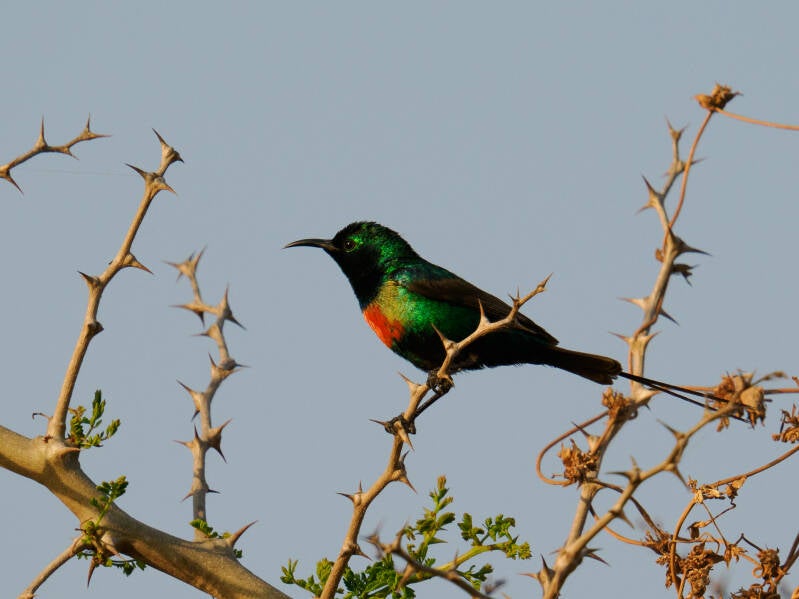
Late afternoons in Kotu during August and September offered a fascinating glimpse into the territorial behaviour of the Beautiful Sunbird. I watched a resident male defend two separate patches rich in nectar: a flowering black acoustic tree and a nearby stand of tall grasses dotted with bright yellow blossoms.
The male was constantly on the move. He flitted between flowers to feed, patrolled his territory and often perched on nearby cables to display. When rival males entered either patch, he chased them away at speed, but rarely followed them far beyond his boundaries. He soon returned to his favourite perches to resume his displays, signalling to any nearby females that the feeding grounds were claimed.
His aggression was directed at other males. When two females arrived to feed on the nectar, he tolerated them and made no attempt to drive them away. This contrast is a striking example of resource-defence polygyny: by securing rich food sources, a male can attract females to his territory and gain opportunities to court them.
By the first week of September, the pattern changed. The flowers on the black acoustic tree began to fade, while the yellow blooms in the grass withered. The male’s activity in the area soon declined, and he eventually abandoned the territory, presumably moving to another place where flowers were more plentiful.
It was a vivid reminder of how the quality of a territory and the availability of food can shape a male’s presence — and influence whether females visit.
Add comment
Comments