

First sighting — 8 August
Lamin Jobaate reports two evening sightings of a Brown-necked Parrot over Kotu and considers whether the area could form part of a regular feeding or roosting route.
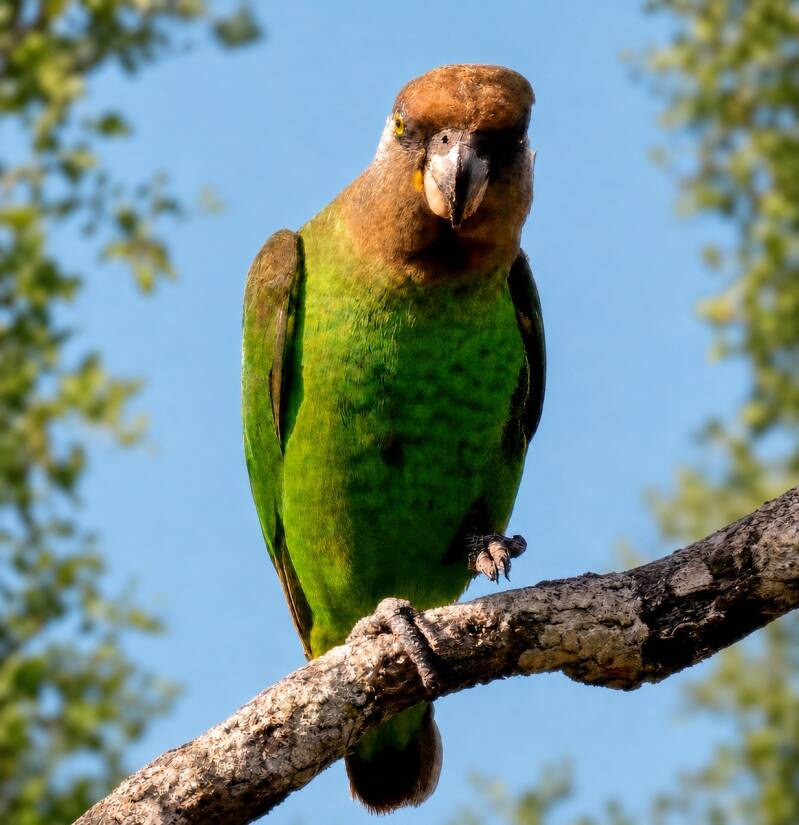
On 8 and 14 August, I observed a single Brown-necked Parrot (Poicephalus fuscicollis) flying over Kotu. Both sightings occurred during the evening, but the bird was travelling in a different direction on each occasion.
The first observation was shortly after 6 p.m. The weather was calm, with very little wind, and approximately 90% of the sky was covered by dark clouds.
The parrot appeared to be flying from the direction of the golf-course area towards the west. At the time, I assumed it had been feeding near the golf course and was travelling towards an evening roost.
Second sighting — 14 August
The second sighting was slightly earlier in the evening. The sky was less heavily covered by cloud than during the first observation.
On this occasion, the parrot was flying in the opposite direction—from the west towards the golf-course area. This movement made me reconsider my original assumption. It suggests that the golf-course area could serve as a feeding or roosting location, or form part of a regular movement corridor for the species.
Two observations are not enough to reach a firm conclusion, but they raise an interesting question about how Brown-necked Parrots use the Kotu area during the evening.
An exciting coastal observation
The Brown-necked Parrot is a sought-after species for visiting birdwatchers in The Gambia. Birders who miss it at coastal locations may travel more than 100 kilometres inland for another opportunity to see it.
Recording the species twice within a short period was therefore exciting news for my birdwatching colleagues. These sightings suggest that Kotu may be an important evening flyway or stopping point for Brown-necked Parrots.
Conservation status
BirdLife currently lists the Brown-necked Parrot as Least Concern. Even so, local records and continued monitoring are valuable for understanding how the species uses coastal habitats in The Gambia.
Further monitoring recommended
More evening observations are needed to understand these movements. Recording the time, direction of flight, weather conditions and number of birds could help establish whether the sightings were isolated events or part of a regular pattern.
I encourage birdwatchers in and around Kotu to report any further sightings.
Add comment
Comments