

How to Find the Abyssinian Ground Hornbill in The Gambia
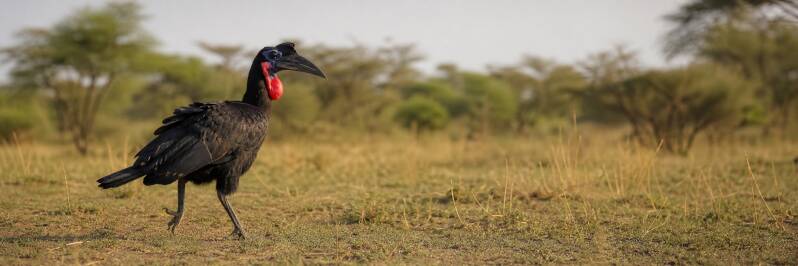
The Abyssinian Ground Hornbill is an unmistakable, turkey-sized bird of open savannah and dry woodland. Its huge black body, bare facial skin and deep booming calls make it one of the most impressive birds on an upriver journey through The Gambia.
Identification
Adults are mostly black with white primary feathers that flash in flight. Males have red bare skin around the face and throat, while females show a blue throat patch. The powerful bill is adapted for taking large prey on the ground. Birds often walk slowly in pairs or small family groups.
Best locations for sightings and photography
Kiang West National Park and other open woodland and savannah areas farther inland provide the strongest opportunities. Lamin watches quiet tracks, recently burned grassland and open patches where birds can search for food. Their large territories mean local knowledge and an early start can make a major difference.
Behaviour and diet
Abyssinian Ground Hornbills are mainly terrestrial and feed on insects, reptiles, frogs, small mammals and other available prey. They are strong fliers despite spending much of the day walking. At night they roost safely in trees. Their slow breeding rate and dependence on large nest cavities make undisturbed habitat particularly important.
Photography tips
Allow the birds to approach naturally and avoid blocking their route. A vehicle can provide a useful hide, while a medium or long telephoto lens captures both portraits and wider habitat scenes. Their white wing panels create dramatic flight photographs if a bird moves between feeding areas.
Best time to see them
The dry season from November to April offers comfortable travel and good access to inland sites. Because the species ranges widely, sightings can never be guaranteed, but Lamin can combine recent information with suitable habitat and build the search into a private upriver itinerary.
Want to add this magnificent bird to your life list? Contact Lamin to plan a customised excursion, or explore more Must-See Birds in The Gambia.