

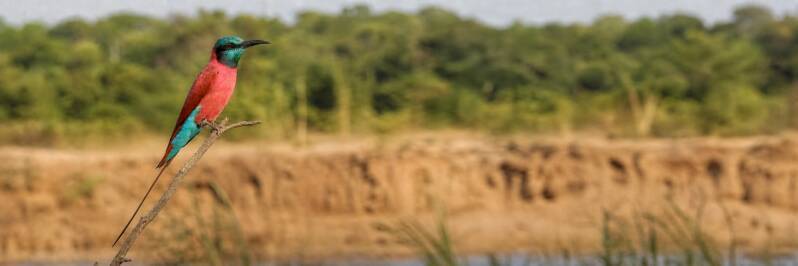
Northern Carmine Bee-eater in The Gambia
Merops nubicus
See this bird with local guide Lamin: 7-day Gambia birding tours from £1,250 per person, day trips from £45. Book a Gambia birding tour
Overview
Few birds bring more colour to an upriver journey than the Northern Carmine Bee-eater. Flocks sweeping over fields or gathering on bare trees create one of the defining wildlife spectacles of inland The Gambia.
Identification
The adult is predominantly glowing carmine-red with a turquoise crown and rump, a black mask and long pointed wings. Juveniles are duller and shorter-tailed, but the slim shape and fluid, fast flight remain distinctive.
Habitat and behaviour
It frequents rivers, floodplains, farmland and open savannah, often perching conspicuously before sallying after flying insects. Colonies excavate nesting tunnels in steep sandy banks, while feeding groups may associate with livestock or grass fires that flush prey.
Birdwatching in The Gambia
Basse and the upper River Gambia region are classic areas, with birds also occurring across productive inland habitats according to season. Numbers and locations can shift, so an extended tour offers the best flexibility.
Field note
Watch overhead as well as along wires and dead branches. Lamin Jobaate can combine this target with Egyptian Plover, red-throated bee-eaters and other upriver specialities on a tailored Gambian birdwatching trip.
Plan your birdwatching tour: Ask Lamin Jobaate about a private itinerary for this species and The Gambia’s other outstanding birds.
Explore the best birding locations in The Gambia
Field tips for seeing the Northern Carmine Bee-eater
The Northern Carmine Bee-eater is a dry-season highlight in The Gambia. Large, sociable and brilliantly coloured, it nests in colonies, digging burrows into sandy riverbanks and earth cliffs upriver. The colonies are busiest in the later part of the dry season, when hundreds of birds can be seen coming and going.
Look for a long-tailed, carmine-red bee-eater with a blue-green crown and throat. Away from colonies, carmines often gather where insects are disturbed: they follow grass fires, livestock and even large birds, catching insects flushed into the air. At a colony, keep well back from the bank so the birds continue their normal activity; a long lens and a seat in the shade will give far better results than approaching closely. Combining a colony visit with other upriver sites makes an outstanding birding day.
Where to look for Northern Carmine Bee-eater in The Gambia
These sites have suitable habitat and fit well into a planned birding itinerary:
- Bansang Quarry & Wassu: sandy banks, dry savannah and upriver farmland
- Kaur & Njau Waterholes: inland waterholes, dry savannah and riverbank country
- Tendaba: mangrove creeks, freshwater pools, savannah and the River Gambia
These are places with suitable habitat, not guaranteed sightings. Season, tide, water level and recent local activity all affect where a bird is found.
Want to see the Northern Carmine Bee-eater with Lamin? Ask about dates for a tailored trip, or see the 7-Day Gambia Birding & Photography Tour from £1,250.