

Observer: Lamin Jobaate
Location: Kotu, The Gambia
Survey period: August 2026
Observation dates: 2, 15, 18, 20 and 29 August 2026
During August 2026, acoustic point-count surveys were conducted at two sites in Kotu to record the presence and activity of the Diederik cuckoo (Chrysococcyx caprius).
SITE K1: THE MAIN ACTIVITY AREA
Site K1 was centred on a mature, fully leaved Parkia biglobosa tree. This proved to be the cuckoos’ main area of activity, with birds detected on several occasions.
Calls were heard during both the morning and evening. Morning observations included calls at 09:18 and 09:26, while an evening call was recorded at 18:30.
The male repeatedly gave a “dii-dii-dii-dit” vocalisation, believed to be an advertisement call. A female was also heard producing a softer, chattering “tyrr-tyrr” call. The presence and vocal behaviour of both birds may indicate pair formation and the establishment of a breeding territory.
Calls generally came from the northeast, although the birds were sometimes heard flying directly overhead. Their estimated distance from the observation point ranged from approximately 50 to 300 metres.
SITE K2: LIMITED ACTIVITY
Site K2 contained a large, leafless acacia tree with several abandoned weaver nests and two inactive white-billed buffalo-weaver nests.
Only one cuckoo observation was recorded here during August. The absence of active nests belonging to potential host species may help explain the site’s lower level of use. It is also possible that K2 previously served as a roosting or breeding area.
POTENTIAL HOST SPECIES AND OTHER BIRDS OBSERVED NEARBY
Birds recorded in the surrounding area included:
• Village weaver
• Little weaver
• Northern red bishop
• Red-cheeked cordon-bleu
• Red-billed firefinch
• Grey-headed sparrow
• Common bulbul
• Long-tailed sunbird
• Variable sunbird
The presence and activity of local weaver colonies are particularly relevant to understanding the cuckoo’s breeding ecology.
CONCLUSION
The repeated observations and variety of calls recorded at K1 suggest that it was an active territory during the survey period, with possible breeding behaviour taking place. K2 appeared to be of secondary importance, although its abandoned nests suggest that it may have been used more frequently in the past.
Further monitoring—particularly of active weaver colonies—would help clarify how the cuckoos use these sites and whether breeding occurs in the area.
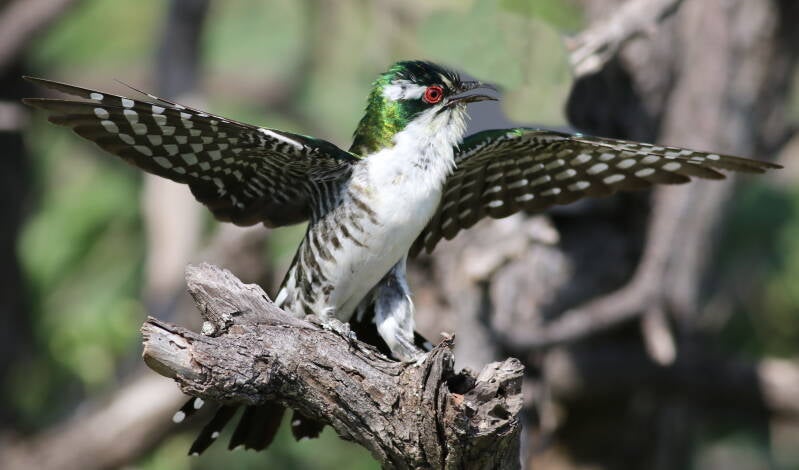
Image: Male Diederik cuckoo at Mapungubwe National Park, Limpopo, South Africa. Photograph by Derek Keats, CC BY 2.0. Source: https://commons.wikimedia.org/w/index.php?curid=52061811
Add comment
Comments